
introduction
Understanding what Gen Z really think about AI.
The generation raised online is widely seen as souring on AI. Historically, the young have been quick adopters and vocal supporters of new technologies.
But today, Gen Z (born between 1997 and 2012) are booing mentions of AI in commencement addresses at colleges across the US and voicing scepticism about what this new technology means for them. Gen Z are the first generation to enter work and adulthood alongside AI – and may have the most to gain and the most to lose from it. Organisations that want the public to trust what they say about AI need to hear Gen Z out first.
To understand what Gen Z really think, Milltown surveyed a nationally representative sample of 6,429 adults living across the US and the UK, including a boost of 3,092 Gen Z respondents. We also held four online focus groups with Gen Z, two in each market. The research asks how Gen Z feel about AI, what shapes those views and what they expect from today’s technology companies.
EXECUTIVE SUMMARY
Gen Z are widely portrayed as a generation turning against AI, yet our research finds a generation still making up their minds.
We found that:
1
Faced with an uncertain future and tough job market, Gen Z feel they have to look out for themselves. 78% think they’ll have to work harder to get ahead than their parents, and 50% see freelancing or content creation as safer than a traditional career. They’re forming their views of AI against that backdrop.
2
Any AI backlash is not driven by Gen Z alone. 50% of Gen Z expect AI to harm society, on par with Baby Boomers and almost equal to Gen X. Millennials are the only generation to feel more optimistic than pessimistic about AI’s impact.
3
Gen Z are less concerned than older generations about catastrophic AI risks, and more concerned about ‘what AI means for me’. Compared to older generations, Gen Z are actually less concerned about safety and security risks from AI, such as AI threatening humanity, proliferating misinformation or being used to create dangerous weapons. But they are more likely to fear how it impacts their day-to-day life. 29% of Gen Z say it is making them worse at thinking for themselves, 21% that it is already making it harder for them to find work and 30% say they feel guilty about using AI.
4
Most of Gen Z (73%) have not yet made up their minds about AI and could still be persuaded on potential AI use cases. They welcome AI that helps with everyday tasks, advances science and aids learning. But they draw firm lines where it acts without a person or replaces human judgement and creativity. They are also the generation most likely to act on this, with 31% saying they’ve stopped using a product because of its use of AI.
5
Gen Z want companies to talk about both risks and benefits of the technology. Trust in the companies building AI starts low, so they want to hear about how human control remains as AI develops further.
AN UNCERTAIN CONTEXT

It’s not just Gen Z who are trying to work out what they think of AI. All generations are responding in real time, trying to keep up with the implications of AI’s rapid pace of change.
But there are three key ways in which Gen Z differ from older generations. First, they are adapting to AI at the beginning of their adult lives, a time when the future feels particularly uncertain. Second, they are facing a particularly tough job market. And, third, they are much more at home than older generations in the modern technological landscape.
Navigating uncertainty
Gen Z are having to adapt to AI at the same time that they are taking their first steps in adult life. Many are finding their feet with work while the workplace is changing fast. They are having to think about their futures at a time when predictions about what the future might look like vary widely.
Gen Z are more likely to view freelancing or content creation as safer than traditional careers
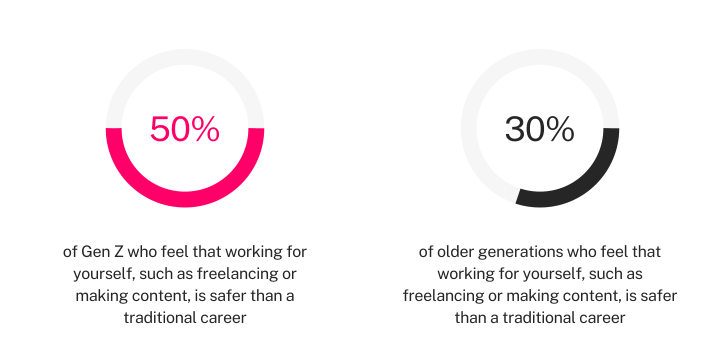
Faced with an uncertain future, Gen Z are embracing self-reliance and a do-it-yourself mindset. 50% say that freelancing or creating content is safer than a traditional career, compared to only 30% for older generations. In focus groups, when asked for an object to sum up life for Gen Z today, Ana from Kansas felt a coffee mug represented “the hustle culture” she had to embrace when job-searching. “I feel like I was constantly going, going, going, competing with so many people.” Isaac from Manchester chose a chessboard because “you have to be quite strategic nowadays and make the right moves.”
That self-reliance shapes what Gen Z want from AI. They are most comfortable with AI that helps them do things for themselves, such as explaining hard topics (72%). Conor, in the UK, said ChatGPT gave him the exact fix for a DIY problem he couldn’t solve from reading forums. The same instinct explains the wariness: 29% say AI is making them worse at thinking for themselves, and only 22% feel they have enough control over how AI shows up in their lives.
An uncertain future
Eight in ten Gen Z expect to work harder than their parents did
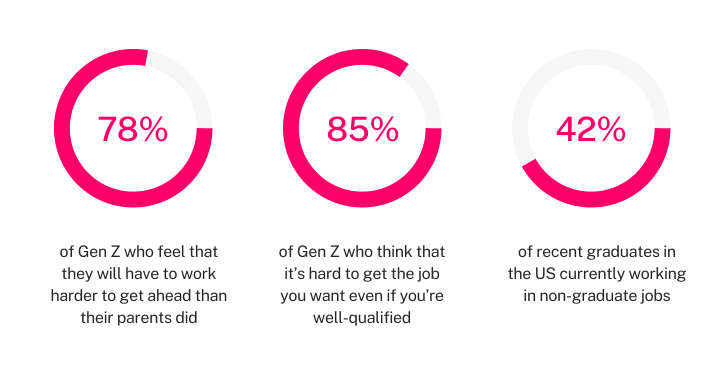
Gen Z also feel that the odds are stacked against them in the job market. Gen Z overwhelmingly say that they will have to work harder to get ahead than their parents did (78%), and that it's hard to get the job you want even if you’re well-qualified (85%). With 42% of recent graduates in the US currently working in non-graduate jobs, their fears are understandable.
Many simply feel like the rules of the game that applied to older generations no longer apply today. The result is cynicism about how the economic and political system is set up and who it benefits. 69% believe that the political system is rigged in favour of the wealthy, and 61% say that large companies extract wealth from ordinary people, compared to 63% and 51% respectively for older generations. In the focus groups, participants expected executives and big companies to benefit most from AI. For companies, there is therefore a need to show what AI does for ‘people like them’, and to be clear about who gains from the technology’s developments.
“
Which object sums up life for my generation today? A Rubik’s cube… It feels like certain things just don’t make sense. There’s no order and there doesn’t seem to be like a path forward.
—US, Older Gen Z
Raised on technology, wary of its pull
Gen Z grew up online, and when we asked them to choose an object that represents life for their generation today, the phone was the most common choice. Familiarity has not made them uncritical. 59% say they are deliberately trying to spend more time offline, compared with 43% of older generations.
Yet Gen Z also push back on the idea that they are the ones glued to their phones. “I think the stereotype is that we’re worse,” Hannah from Newcastle told us. “But my uncle for example, he’s always on his phone all the time… a lot of them are just as bad.” Emily from Liverpool said older generations complain about phone use, but the world is now set up so that everything runs through one. Two in three (65%) say smartphones have made life better for their generation, about the same as older generations (67%). Gen Z seem less bothered by being called the ‘tech generation’ than by being judged for something they see as unavoidable.
This is the backdrop for how Gen Z respond to AI: a generation that knows technology well enough to see its costs and are already weighing what the next wave means for them.
IS THERE A GEN Z AI BACKLASH?

Any AI backlash is not driven by Gen Z alone
Gen Z are not the only generation to have reservations about AI. In fact, AI scepticism unites the youngest and oldest in society. 50% of Gen Z believe AI will have a negative social impact, compared to just 39% of Millennials. Gen Z have more in common with Baby Boomers (50% concerned) and Gen X (48%), than with Millennials.
Within Gen Z, the younger you are, the more likely you are to have concerns. 18-24-year-olds hold the most negative views of AI of any age group, with 56% predicting that AI will have a negative social impact.
Gen Z are heavier users than Gen X or Boomers but just as pessimistic
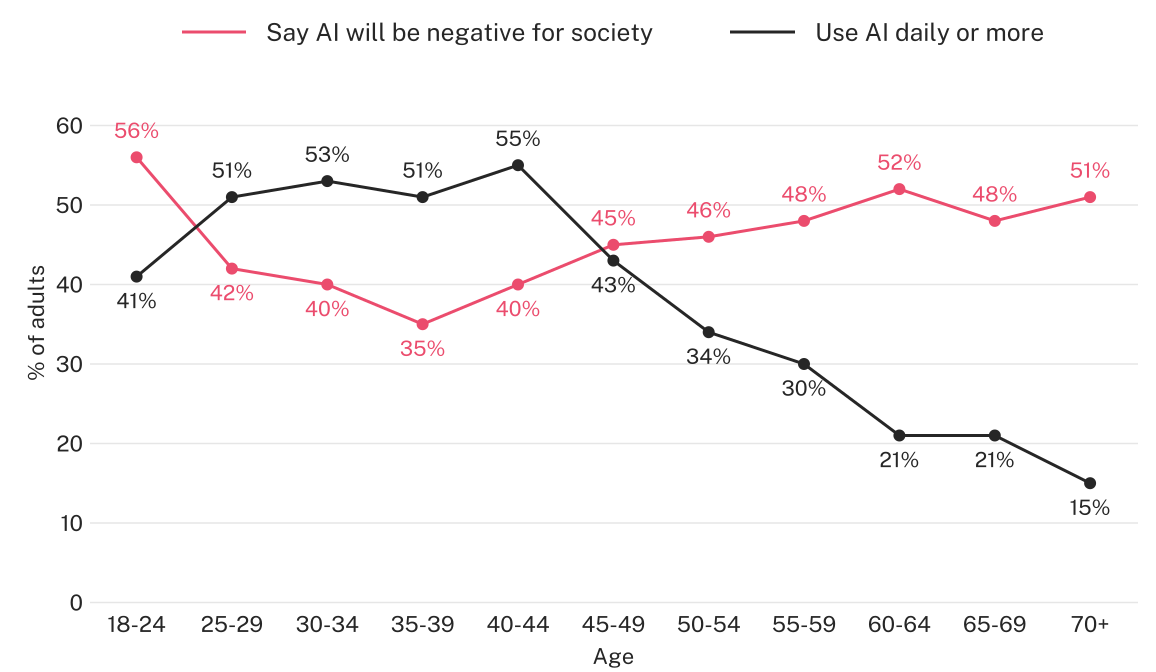
What sets Gen Z apart from Gen X and Baby Boomers, however, is that they are actively using AI despite these reservations. 46% of Gen Z use AI daily, more than the rate for Baby Boomers (18%) and Gen X (33%), and slightly below Millennials (53%). But even among Gen Z who use AI every day, one in three (33%) expect it to harm society.
Personal anxiety, not social risks
This means that Gen Z’s AI anxiety takes a unique form. Their concerns are personal, centred on what AI means ‘for me’, more than the social risks that dominate the headlines.
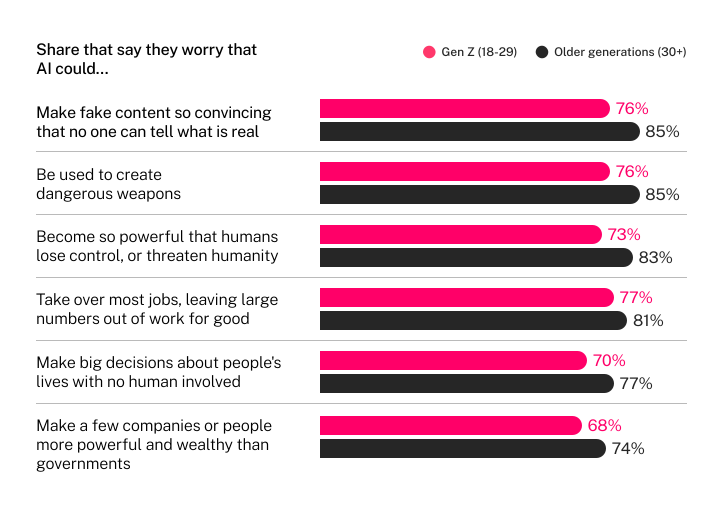
Gen Z are actually less concerned than older generations about many of the most prominent social risks associated with AI. Take the risk that an out-of-control AI could pose a threat to humanity. 73% of Gen Z say this concerns them–a high proportion, but lower than the 83% of older generations who say the same. The same is true for other risks. Whether it is dangerous weapons, fake content, or even job loss, for each, Gen Z are less concerned than older generations.
Gen Z are less worried than older generations about major societal AI risks
Gen Z worry more than older generations about how AI is affecting them personally day-to-day, rather than in a hypothetical future. Gen Z are more likely than older generations to worry that AI is making them worse at thinking for themselves (29% say so, compared to 19% of older generations). They are more than twice as likely to say that AI has made it harder for them to find work (21% to 9%). And they are twice as likely to say that AI has affected their mental health (12% to 6%).
Gen Z more likely to report personal downsides of AI
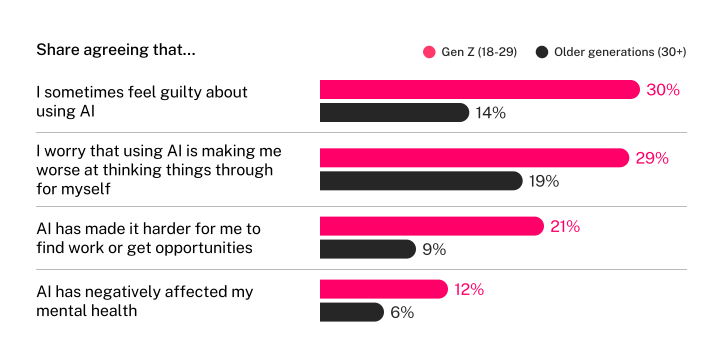
These sorts of personal, immediate concerns were more likely to come up in focus groups than catastrophic or existential risks, signalling that while there’s broad concern on prominent societal risks when prompted, the day-to-day concerns are more top-of-mind. Concerns about cognitive decline in particular came up again and again. “I do notice it kind of reduced my abilities to construct anything on my own,” Mia in London told us. Shaiann in New York said the same. “I think I’ll become more lazy, unfortunately. I would try to do things for myself and be self-sufficient. But if you have so many things that can be done for you without even thinking about it, it’s just going to make you more reliant on that.”
AI guilt
This combination of worrying about AI but using it anyway is leading many Gen Z to experience AI guilt.
30% of Gen Z say they sometimes feel guilty about using AI, over twice as many as older generations. For some, this is due to ethical concerns. Harpreet in Birmingham told us he feels guilty because “it is absolutely horrible for the environment… its water use, its energy use.”
Others attribute their guilt back to the fear that AI is making them “lazy,” and that overreliance on AI may be hurting them in the long term. Emily from Liverpool said that she “didn’t know how [she’d] done the first years [of university] without it now… [but] you probably are depending on it for the wrong reasons.” Notably, AI guilt is highest among students, 43% of whom say they feel guilty for using it, and 33% that it is making them worse at thinking for themselves. But, across Gen Z as a whole, guilt falls as usage rises: only 27% of daily AI users feel guilty about it, compared to 43% of rare users.
“
I think I’ll be a little bit more lazy because I already don’t feel like doing things… I think I’ll become more lazy, unfortunately. I would try to do things for myself and be self-sufficient. But if you have so many things that can be done for you without even thinking about it, it’s just going to make you more reliant on that.
—US, Older Gen Z
Work status shapes Gen Z’s view
Of all the major social risks typically associated with AI, concern about jobs was the one we heard about the most in our focus groups. In the survey, when asked to write the AI risk they are most concerned about, 26% of Gen Z entered something related to jobs, the most of any issue.
Gen Z outside paid work are linked to more negativity about AI. Those with a job feel notably different from those still studying or out of work. Employed Gen Zs are the heaviest users of AI, with 51% using it daily and they are roughly split on whether AI is good or bad for society, with 38% positive, 45% negative. 52% of employed Gen Z expect AI to have a positive impact on them personally, compared with 36% of students and 33% of those out of work. Students and those out of work are far more negative, with two in three of each group (65% of students, 62% of out-of-work) thinking AI will harm society. This is likely linked to concern about career prospects.
Job seekers want AI on their side but are wary of hiring employers using it too. Shaiann in New York and Kali in Texas wished AI would help them apply for jobs, yet acknowledged that the screening tools employers use could miss good candidates. For companies, the opportunity is less about promoting AI as a career tool and more about demonstrating that it is being used fairly, with transparency about how it features in hiring decisions. The challenge for companies is not convincing young people that AI is useful, but showing they are on their side as it changes the job market.
“
The job I’m in, I can already see that AI could 100% do this. If it’s already reducing my workload by like 90% and we’re only at the start, then yeah, I can’t really see myself doing this for much longer. So I might pivot myself at some point.
—UK, Younger Gen Z
GEN Z HAVEN’T MADE UP THEIR MINDS

Most of Gen Z are still working out what exactly they think about AI. Only 27% say their mind is made up and unlikely to change, leaving 73% who say they could change their mind or are still forming a view. Even among those who are most negative about AI, only 33% say they’re unlikely to change their opinion.
This gives the companies building AI an opportunity. Opinion is not yet settled, and opposition to AI may be shallower than it would first appear. Instead, we find that views can differ widely depending on the context in which AI is used.
We tested 33 use cases for AI to see which are welcomed, and which rejected. Across most of the 33, Gen Z and Millennials are much more open than Gen X and Boomers. But Gen Z draw the following lines:
What Gen Z wants from AI
1. Keep people in the loop
Gen Z’s firmest red line is AI acting on its own. Half say a business run entirely by AI, with no human staff, should never happen (51%), and nearly as many say the same about AI making purchases on their behalf (48%). By contrast, AI that leaves the final decision to a person is much more likely to be welcomed, even in very similar contexts: 65% are comfortable with AI finding goods or services for them to buy, but only 31% with AI completing the purchase.
“
I don’t think leaving the human out of this is a good idea. Humans should be involved in all decisions AI takes.
—US, Younger Gen Z
2. Avoid the uncanny valley
Gen Z are uncomfortable with AI that seems to mimic humans. AI-generated actors (47% say should never happen) and AI-generated influencers (also 47%) are near the bottom of the list, with humanoid robots (39%) and AI chatbots as friends or companions (29%) close behind.
3. Preserve creativity
Gen Z push back on AI in creative work. Four in ten (40%) say AI music on streaming services should never happen, with 47% saying the same of AI-generated actors in film and TV.
But the objection is to AI replacing creative work, and Gen Z are more relaxed about AI that supports it. 54% are comfortable with films and TV using AI for visual effects, nearly double the figure for AI actors. 58% are comfortable with AI characters in video games, and 41% are comfortable with AI images in marketing. AI that helps artists is accepted, while art produced by AI alone is rejected as lacking “soul.”
“
People turn to music and movies to feel and connect in some form. Replacing that with AI would completely take that experience or connection away.
—US, Younger Gen Z
Millennials are much more comfortable with AI in creative work than Gen Z. 73% are comfortable with AI visual effects, 59% with AI images in marketing, and 51% with AI music.
4. Help with everyday tasks
Gen Z are most comfortable with AI that handles the practical, everyday business of life. Seven in ten are comfortable with students using AI to explain topics they find hard (72%) and with live translation earbuds (73%). Around two in three are comfortable with AI finding goods or services to buy (65%), drafting work emails and documents (63%) and acting as a tutor (64%).
Comfort falls as the stakes rise. On sensitive personal matters, Gen Z are split: 44% are comfortable with AI chatbots giving health advice, 49% with AI offering emotional support and 51% with AI giving financial advice. They are more wary when AI moves into their relationships. Only 38% are comfortable with AI chatbots as friends or companions, and 35% with AI writing messages to friends or family for them, compared with 63% for work emails.
5. Physical AI as accessories
Gen Z welcome new AI devices that they wear and can control, but are more wary of AI that acts autonomously in the physical world. Live translation earbuds are among the most popular use cases, with 73% comfortable with them in the survey and Gen Z highly enthusiastic about them in focus groups. Similarly, 56% are comfortable with AI glasses or wearables.
The picture changes for physical AI that acts without a person. Only 38% are comfortable with driverless cars, and 29% say they should never happen, while only 35% are comfortable with humanoid robots, and nearly four in ten (39%) say they should never happen.
6. Yes on science, more cautious on health
Most Gen Z are comfortable with AI being used by scientists to develop solutions to problems (55%), but are more cautious about AI in healthcare, whether that is health advice from chatbots (44% comfortable) or even health professionals using AI for diagnosis (42%).
Notably, these are areas where Millennials are significantly more enthusiastic, with 68% comfortable with AI for science, and 56% for AI used in diagnosis.
Gen Z’s wariness shows up in what they do as well as what they say their opinions are. Older generations worry about AI just as much, if not more, but Gen Z are the most likely to act on their concerns. 38% of US Gen Z have chosen something just because a person made it, compared with 30% of Millennials and 13% of Boomers, and 30% of US Gen Z have stopped using or avoided an app because of AI, against 14% to 19% of other generations.
THE MESSAGES THAT MOVE THE DIAL

When shown different directions for corporate messaging on AI, every one of the seven messages tested improved Gen Z’s views of AI. This matters because it shows that Gen Z’s views are not locked – the companies that are deliberate about the positive narrative they’re telling can help determine where they settle.
Messages about science, keeping people in charge and AI as a helper rather than a replacement did best, while the creativity message was weakest. Between 52% and 63% of Gen Z found each one believable.
Gen Z are open to hearing what AI can do for people, and companies should not hold back from making the case. The messages that did best named a concrete benefit, such as scientific discovery or assisting humans on repetitive tasks, while the generic time-saving message did less well.
Some messages are harder to land with some groups. Among AI critics,1 two of the seven messages made views of AI worse, with the creativity message doing the most damage, and two others made almost no difference. The creativity message also had a slightly negative effect among Gen Z women. Three messages still moved AI critics in the right direction: keeping people in charge, AI as a helper rather than a replacement and science.
When asked if they want to hear more about the benefits or the risks of AI, views were split – with 43% wanting companies to talk more about AI’s risks, against 38% who want more on its benefits. AI critics (60%) and women (51%) lean towards hearing about risks, while men lean towards benefits (47%). They also want companies to look ahead, with 45% preferring a focus on the future and 29% on what AI does today. When commenting about AI stories in the media, Harpreet from Birmingham found the current coverage tiring: “every headline is like AI is bad for the environment... AI is making people redundant. And we never hear about anything being done to prevent it.” This outlines a clear appetite for positivity use cases and proactive mitigation stories.
1. AI Critics: those who say AI will have a negative impact on society.
The ‘human touch’ needs to remain for AI development and messaging
Out of the seven messaging concepts about AI tested in the survey, the one that had the most impact on AI sentiment promised to keep humans ‘in the loop’ (+32) – meaning individuals decide when AI is used, and a real person is accountable. The message that performed worst promised AI would make people more creative.
Gen Z participants explained to us that they want AI chatbots or applications to be straightforward about what it can and cannot do, and for someone to be held accountable when it goes wrong. For example, when it comes to things like AI offering emotional support and advice, Mia from London said she’d like AI to be open about its limits and to push back when someone asks for something unreasonable. She also wanted it to remind people it is an AI and not human if they have been talking to it for a long time.
Any positive message improves Gen Z’s view of AI
The messenger matters as much as the message
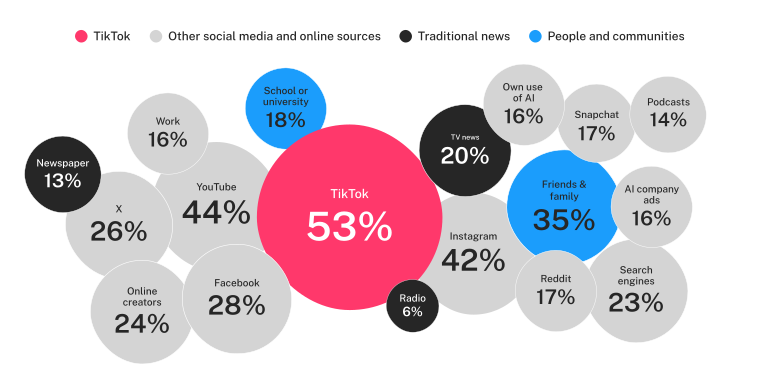
More Gen Z hear about Al on TikTok than on TV news and newspapers combined
Share of Gen Z who usually see or hear information about Al on each. Circle area shows the share
Source: Milltown Partners survey, October 2026. Gen Z, weighted. Respondents could choose several sources."TV news and newspapers combined" counts each person once (28%).
Gen Z learn about AI mostly through social media. TikTok is the most common source at 53%, ahead of YouTube (44%) and Instagram (42%), with X at 26%. TikTok reaches more women (61%) than men (45%) and more 18-24s (58%) than 25-29s (46%), while X skews male (32% of men against 20% of women).
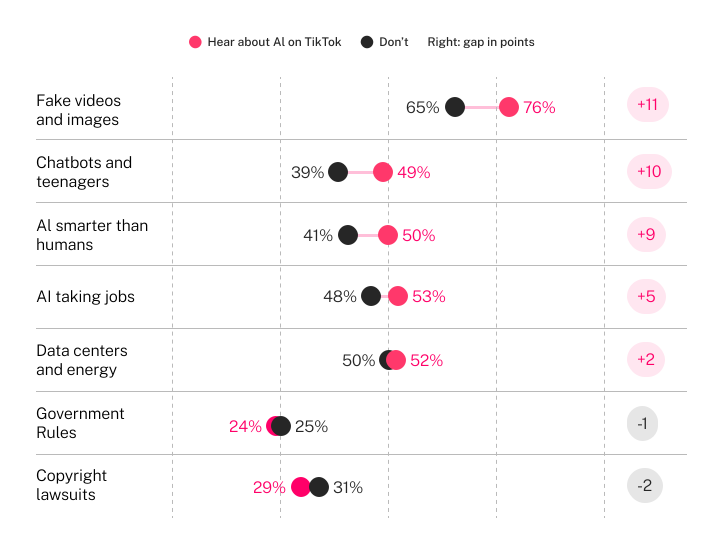
Companies that are not shaping the AI conversation on these platforms leave it to others. Gen Z who get their news from TikTok are currently more likely than those who don’t to hear negative news about AI. This is the case across a range of topics, including fake news and deepfakes, teenage chatbot use, AI being smarter than humans and AI taking jobs.
The messenger matters too. Kate from Birmingham said she becomes uncomfortable when millionaires promote AI, because she wonders what their motive is, while hearing ordinary people talk about it feels far less threatening.
Gen Z who get Al news from TikTok hear more about deepfakes and chatbots
Share who have heard a lot about each Al story: Gen Z who get Al news from TikTok, against Gen Z who don't
Source: Milltown Partners survey, October 2026. Gen Z, weighted. Bases: 1,670 who hear about Al on TikTok, 1,422 who don't.
CONCLUSION

Gen Z’s views on AI are still forming, and the companies that earn their trust now will help decide where those views settle. Only 34% trust AI companies to do their part in making AI safe and fair, so these five principles are about building that trust.
5 principles for building trust with Gen Z on AI
1
Treat their views as open
Only 27% of Gen Z say their mind is made up, and every one of the seven messages tested improved their views of AI. Trust is still there to be earned, and more amplification of positive stories and use cases can move the needle.
2
Start from what Gen Z share with other generations
Gen Z have more in common with older generations than the headlines suggest. 50% expect AI to harm society, in line with Gen X (48%) and Boomers (50%), and they are less concerned than older generations about most of the societal risks. They differ in the personal, day-to-day effects, above all around work. 21% say AI has made it harder for them to find work, against 9% of older generations. Companies should speak to Gen Z as part of the wider public and be concrete about job security.
3
Speak to different Gen Zs differently
Where Gen Z stand in life shapes their view of AI more than how often they use it. Two in three students and people out of work expect AI to harm society, and they are less likely to expect a personal benefit (36% and 33%, against 52% of employed Gen Z). Women lean towards hearing about risks (51%) and men towards benefits (47%). Companies should show students and job seekers what AI means for work and skills, and show people in work what it does for their career trajectory.
4
Keep a person visibly in charge
Gen Z are more comfortable with use cases where AI assists them and are more resistant towards AI that acts on its own. Messaging that promised that people stay in charge was the most believable of the seven tested (63%) and the strongest with AI critics. Companies should be transparent about the mechanics, such as who decides, how to control AI and who answers when something goes wrong. That speaks to fears of AI going rogue and works better than reassurances about data privacy or training. They should also present AI as amplifying human skill, not substituting for it, especially in creative work.
5
Be a hopeful leader
Gen Z are looking for leaders who can talk about what AI does for people in specific terms and who are just as clear about what they are doing to prevent harm. The science message, which named concrete discoveries in health and energy, had the second-biggest net impact, while the generic time-saving message was weaker, though still positive. Companies should lead with a named benefit, then explain the safeguards, especially on the channels where Gen Z get their news from, led by TikTok (53%).